Problem Formulation
Given vectors , we would like to find vectors such that the build an orthonormal system, i.e.
and
The most popular algorithm to solve this problem is probably the Gram-Schmidt orthogonalisation. The algorithm is named after Erhardt Schmidt and Jørgen Pedersen Gram. Schmidt published the algorithm in 1907 [5] but claims in his work that the method can already be found in Grams work from 1883 [6]. The first reference to the "Gram-Schmidt" Algorithm probably comes from [7]. Finally, a well readable historical overview is given in [4]
Classical Gram-Schmidt
Finding is rather straightforward. The first requirement tells us that must have length 1 and the second equation tells us that it must be parallel to . The obvious choice is therefore to set
In order to get the second vector lets have a look at our current situation in the sketch below.
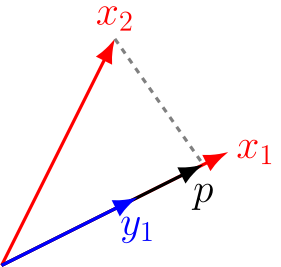
We know . It's given by . Thus it follows that the vector going from to is given by . From the sketch it's obvious that will be orthogonal to and thus a perfect candidate for . This gives us an idea for a general formula
and we end up with the following algorithm
Classical Gram-Schmidt Algorithm:
1. set $y_1 = \frac{x_1}{\lVert x_1\rVert}$
2. for $j = 2, ..., k$ compute:
   $$\begin{align*}
   y_j &= x_j - \sum_{i=1}^{j-1} \langle x_j, y_i\rangle y_i \\
   y_j &= \frac{y_j}{\lVert y_j\rVert}
   \end{align*}$$
In Julia, classical Gram-Schmidt can be implemented as follows.
using LinearAlgebra

function classical_gram_schmidt_alt(matrix)
    # orthogonalises the columns of the input matrix
    num_vectors = size(matrix)[2]
    orth_matrix = zeros(size(matrix))
    for vec_idx = 1:num_vectors
        orth_matrix[:, vec_idx] = matrix[:, vec_idx]
        sum = zeros(size(orth_matrix[:, 1]))
        for span_base_idx = 1:(vec_idx-1)
            # compute sum
            sum += dot(orth_matrix[:, span_base_idx], orth_matrix[:, vec_idx])*orth_matrix[:, span_base_idx]
        end
        orth_matrix[:, vec_idx] -= sum
        # normalise vector
        orth_matrix[:, vec_idx] = orth_matrix[:, vec_idx]/norm(orth_matrix[:, vec_idx])
    end
    return orth_matrix
end
Modified Gram-Schmidt
Modified Gram-Schmidt performs the very same computational steps as classical Gram-Schmidt. However, it does so in a slightly different order. In classical Gram-Schmidt you compute in each iteration a sum where all previously computed vectors are involved. In the modified version you can correct errors in each step.
Modified Gram-Schmidt Algorithm:
set for all .
for compute:
If you omit the normalisations, then classical Gram-Schmidt computes
whereas modified Gram-Schmidt computes
If you consider the strategy from a block wise point of view, then you'll notice that you orthogonalize each of your vectors in each step based on your previous orthogonalisation. This does not happen in the classical Gram-Schmidt version but allows you to correct for errors that happened in previous blocks.
In Julia, modified Gram-Schmidt can be implemented as follows.
using LinearAlgebra

function modified_gram_schmidt(matrix)
    # orthogonalises the columns of the input matrix
    num_vectors = size(matrix)[2]
    orth_matrix = copy(matrix)
    for vec_idx = 1:num_vectors
        orth_matrix[:, vec_idx] = orth_matrix[:, vec_idx]/norm(orth_matrix[:, vec_idx])
        for span_base_idx = (vec_idx+1):num_vectors
            # perform block step
            orth_matrix[:, span_base_idx] -= dot(orth_matrix[:, span_base_idx], orth_matrix[:, vec_idx])*orth_matrix[:, vec_idx]
        end
    end
    return orth_matrix
end
The benefits of using the modified Gram-Schmidt algorithm is visible in the plot below. As input, I used different sizes of a regularized version of the Hilbert matrix and computed the operator norm of the matrix , where is the identity matrix and is our output matrix. In a perfect setting the error should be 0.
error_cgs = []
error_mgs = []
for n = 1:10
    H = [1.0/(i+j-1) for i=1:2^n, j=1:2^n] + 0.00001 * I # regularised Hilbert Matrixy
    eye = Matrix{Float64}(I, 2^n, 2^n)                   # Identity Matrix
    H_cgs = classical_gram_schmidt(H)
    H_mgs = modified_gram_schmidt(H)
    append!(error_cgs, norm(eye - transpose(H_cgs)*H_cgs, Inf))
    append!(error_mgs, norm(eye - transpose(H_mgs)*H_mgs, Inf))
end
Please note that the error is expressed in multiples of machine epsilon here.
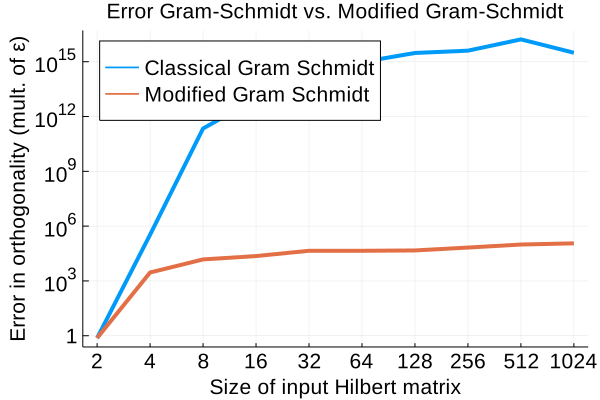
As we can see, the error is increasing much faster in classical Gram-Schmidt than in modified Gram-Schmidt.
It is interesting to note that the following formulation of Gram-Schmidt algorithm (which is really just a better implementation of classical Gram-Schmidt) is referred to as the modified Gram-Schmidt by Schwarz and Rutishauser in [3].
using LinearAlgebra

function classical_gram_schmidt(matrix)
    # orthogonalises the columns of the input matrix
    num_vectors = size(matrix)[2]
    orth_matrix = copy(matrix)
    for vec_idx = 1:num_vectors
        for span_base_idx = 1:(vec_idx-1)
            # substrack sum
            orth_matrix[:, vec_idx] -= dot(orth_matrix[:, span_base_idx], orth_matrix[:, vec_idx])*orth_matrix[:, span_base_idx]
        end
        # normalise vector
        orth_matrix[:, vec_idx] = orth_matrix[:, vec_idx]/norm(orth_matrix[:, vec_idx])
    end
    return orth_matrix
end
Notes
All the code was evaluated with Julia version 1.5.0 (2020-08-01) using the official Julia Docker image.
References
[1] N. J. Higham, Accuracy and Stability of Numerical Algorithms, Society for Industrial and Applied Mathematics, 2002
[2] G. H. Golub and C. F. Van Loan, Matrix Computations, The John Hopkins University Press, 1996.
[3] W. Gander, Algorithms for the QR-Decomposition, Eidgenössische Technische Hochschule, Research Report No. 80-02, 1980. Retyped 2003
[4] S. J. Leon, A. Björck, and W. Gander, “Gram-Schmidt orthogonalization: 100 years and more,” Numerical Linear Algebra with Applications, vol. 20, no. 3, Art. no. 3, 2012
[5] E. Schmidt, “Zur Theorie der linearen und nichtlinearen Integralgleichungen I. Teil: Entwicklung willkürlicher Funktionen nach Systemen vorgeschriebener,” Mathematische Annalen, vol. 63, pp. 433–476, 1907.
[6] J. P. Gram, “Ueber die Entwickelung reeller Functionen in Reihen mittels der Methode der kleinsten Quadrate,” Journal for die Reine und Angewandte Mathematik, vol. 94, pp. 41–73, 1883.
[7] Y. K. Wong, “An application of orthogonalization process to the theory of least squares,” Annals of Mathematical Statistics, vol. 6, pp. 53–75, 1935.
Changelog
2020/09/06: Fixed a bug in the implementation of the classical Gram-Schmidt implementation and adapted the error plots accordingly.
2020/09/19: Added a note about an additional variant of the modified Gram-Schmidt algorithm.
2021/08/17: Added a few historical references to the origins of the Gram-Schmidt algorithm.
How to cite this page
@online{gram-schmidt,
  author   = {Hoeltgen, Laurent},
  title    = {Gram-Schmidt vs. Modified Gram-Schmidt},
  date     = {2021-08-17},
  language = english
  url      = {https://www.laurenthoeltgen.name/content/blog/
              gram-schmidt}
}
CC BY-SA 4.0 Laurent Hoeltgen. Last modified: September 19, 2025.
Website built with Franklin.jl and the Julia programming language.
Privacy Policy · Terms