Let us consider a microphone array comprising microphones at known locations (see figure below). These microphones register the sound that is emitted by a number of sources with unknown locations. The characterization of these acoustic sources requires the estimation of their location and strength.
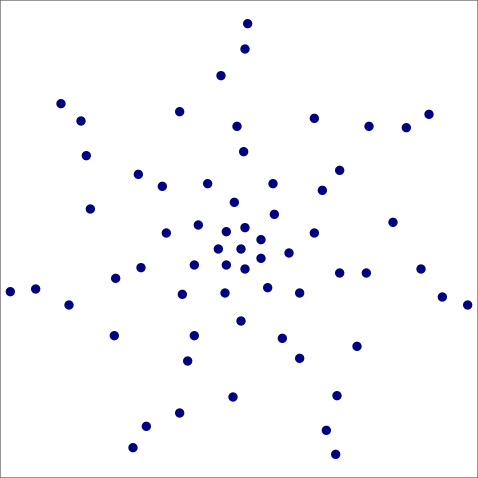
The propagation of sound from a source position to a receiver at position can be modelled by a Green's function. In the following we assume that the source is always a monopole. In that case the sound pressure amplitude at the receiver position for a given discrete frequency is defined by
with being the complex unit, being the source strength, and denoting the distance between the source and the receiver. Finally, the constant denotes the speed of sound. The signals from any given source are evaluated at a known reference point at distance from its source:
Introducing the reference point into our model formulation helps us to eliminate the source strength and leads to the following description
with
The latter equation yields the sound pressure amplitude at a receiver position depending on the sound pressure induced at a reference location by the source.
The estimation approach that we follow here additionally assumes that the real locations of the sources are restricted to possible source locations. Since a superposition principle holds in our model, we can account for multiple sources by adding all contributions. Thus, the sound pressure at a microphone is given by where the sum is taken over all possible source locations . The coefficient is defined in accordance with:
with denoting the distance between sender and receiver .
In a typical setting the number of possible source locations is much larger than the number of microphones, but the number of actual sources is less than . Therefore, most of the in the sum are zero.
Gathering all possible coefficients in a matrix , and using a vector to hold all microphone sound pressures yields
where is the sparse vector of source strengths. Using the Hermitian cross-spectral matrix of microphone sound pressures, we can reformulate the previous equation as
where the operator denotes the expected value and where is the cross spectral matrix of source levels. This matrix is sparse, Hermitian, and in case of uncorrelated source signals also diagonal. By estimating , the task of characterizing the sources is solved.
This task has been analysed and published in Optimization and Engineering and presented at an optimization workshop in Münster, Germany. In our approach we used sparsity favouring convex optimization models and solved these with the split Bregman algorithm. In addition, we used clustering techniques to refine the estimated source locations in presence of noisy measurements.
This work was published and awarded the Howard Rosenbrock Prize 2018.
Source Code
The source code for the accoustic source characterization is here.
How to cite this page
@online{accoustic,
  author   = {Hoeltgen, Laurent},
  title    = {Accoustic Source Characterisation},
  date     = {2020-06-20},
  language = english
  url      = {https://www.laurenthoeltgen.name/content/blog/
              accoustic}
}
CC BY-SA 4.0 Laurent Hoeltgen. Last modified: September 20, 2025.
Website built with Franklin.jl and the Julia programming language.
Privacy Policy · Terms